Responsible AI in Recruitment: A Compliance Roadmap for HR Leaders
A practical framework for deploying responsible AI in recruitment with confidence.
Download the Responsible AI in Recruitment roadmap
2027 Report
How AI is reshaping the workforce, the work, and the candidate heading into 2027.


Introduction
Talent acquisition is no stranger to change. Labor markets tighten and loosen. New skills emerge. Technology changes how recruiters find and engage talent. TA teams have always had to adapt.
What makes this moment different is that AI isn't changing just one part of hiring. It's changing several at once.
AI is reshaping the work people do and the expertise employers value. It is changing how recruiters source, screen, and engage candidates. It is changing how candidates find jobs, apply, prepare, and present themselves. And in some cases, it is making the signals employers have traditionally relied on harder to trust.
Those changes are colliding with a labor market already heavily concentrated on experienced talent. Employers want people who can contribute quickly, exercise judgment, adapt as roles evolve, and work effectively with emerging technology. At the same time, the pathways that develop that experience are changing.
That creates a different challenge for talent acquisition. Doing the same things faster won't be enough.
Heading into 2027, TA leaders need to think critically about where they look for talent, how AI fits into the recruiting process, which candidate signals they trust, and what they are actually hiring people to do.
This report explores those shifts using LevelUP's analysis of global job-posting data alongside research from leading workforce and talent organizations. The goal isn't to predict what AI might eventually do to hiring; it is to understand what has already changed and what TA can do about it now.

Chapter 1
The most experienced segment of the labor market is the one everyone is competing for. But who becomes senior when organizations stop hiring junior?
For most of the past decade, talent acquisition has operated on a quiet assumption: that the pool of people available to hire would, broadly, keep pace with the demand for them.
LevelUP's analysis of global job postings reveals a structural shift that arrived earlier than most expected. In 2026, postings targeting 3–10 years of experience overtook entry-level postings for the first time in six years of tracking, capturing 50.5% of global active postings against entry-level’s 44.5%.
Behind that single-year crossover was a 16.6% year-over-year jump in mid-experience demand, the steepest movement ever recorded across any experience band in the reporting period.
50.5% of active postings now target 3–10 years of experience.
The longer-term pattern is equally telling. Over the past five years, entry-level postings grew at an annual rate of 5.7%, behind the 7.8% overall market pace. Mid-experience and senior roles, by contrast, expanded at 9.3% and 13.9% respectively, outpacing the wider market. Senior roles as a share of all job postings, after holding flat at 3.8% for four straight years, rose to 5% in 2026.
Employer demand is consolidating toward the experienced end of the spectrum, and the trajectory shows no signs of reversing.
| Year | 0–2 years | 3–10 years | 10+ years |
|---|---|---|---|
| 2021 | 49.1% | 47.1% | 3.8% |
| 2022 | 47.7% | 48.5% | 3.8% |
| 2023 | 49.1% | 47.0% | 3.9% |
| 2024 | 49.5% | 46.6% | 3.9% |
| 2025 | 47.6% | 48.1% | 4.4% |
| 2026 | 44.5% | 50.5% | 5.0% |
Source: Lightcast active global job postings. FY = May–Apr period.
On the surface, this looks like a hiring problem to be solved with better sourcing. Beneath that, it is a structural mismatch between what employers are asking for and what the labor market can supply.
Employers are competing harder for experienced talent just as traditional pathways into the workforce are changing. Today's entry-level hiring decisions shape tomorrow's experienced talent pool.
AI is reshaping the entry point. Entry-level roles have traditionally included structured, repeatable tasks, precisely the kind of work AI can increasingly perform. As those tasks shift toward technology, employers are rethinking what entry-level work looks like and what new hires need to contribute from day one. The risk is that fewer traditional entry points also means fewer opportunities to develop the experienced talent employers increasingly want to hire.
The pool employers are hiring from is shrinking. Lightcast has called this dynamic "the middle of the diamond": the long-running employer habit of hiring almost exclusively from the mid-career candidate pool, while systematically excluding candidates on both ends.2 In most developed economies, the workers entering the labor market are not enough to replace the ones leaving it. Continuing to hire only in the middle means competing for a shrinking pool against every other employer doing the same.
The talent shortage is not cyclical. ManpowerGroup's 2026 Global Talent Shortage Survey of 39,000 employers across 41 countries found that 72% of employers report difficulty filling open roles, a figure that has held above 70% for four consecutive years.1 The shortage is not concentrated in one industry or region. Germany sits at 83%, France at 74%, the UK at 73%, and the US at 69%. Information services (75%), hospitality (74%), and healthcare and public services (74%) all report nearly identical strain.1
Entering the Workforce
Leaving the Workforce (Retiring)
By only hiring in the middle of the experience spectrum, organizations remove one-third of potential workers from the talent pool.2
Some employers are responding by rebuilding entry-level programs. EY is extending its assurance internships into a paid, 8-to-12-month "Career Residency" following the traditional eight-week program, concluding that a standard internship no longer prepares young workers for the skills the AI era demands.3 The same shift is visible in apprenticeship data.4
8% ↑ vs 8% ↓ UK companies increased apprentice hiring by 8% in 2025, while graduate hiring fell by the same margin.4
In the UK, companies increased apprentice hiring by 8% in 2025 while graduate hiring fell by the same margin, and firms including PwC, Grant Thornton, and Freshfields have expanded white-collar apprenticeship programs across consulting, tax, technology, and law, reporting no measurable difference in progression compared to traditional graduate hires.4
A standard internship or a straight-to-degree pipeline no longer reliably produces the capabilities that entry-level roles now require, and employers are extending the runway rather than cutting the roles.
 Grant JessupLevelUP Chief Client Officer & SVP, International
The experienced talent shortage can't be solved by competing harder for the same candidates.
The available talent pool is wider than current sourcing strategies assume. Early-career talent, experienced workers later in their careers, and candidates with adjacent capabilities all represent potential supply.
For talent acquisition leaders, the structural shortage changes the conversation with the business. The opportunity is to widen the lens: invest in the talent pipeline, look beyond exact-profile matches, and use labor market intelligence to identify capability in places competitors may not be looking.
The organizations adapting fastest aren't adding more tools or recruiters to compete for the same talent. They're expanding where they look and who they consider.



Chapter 2
Adoption is nearly universal. The question is how well the operating model is keeping up.
AI has rapidly moved from experiment to infrastructure in talent acquisition. It is sourcing candidates, screening applications, matching talent, drafting communications, and coordinating the hiring process.
The opportunity now is turning AI's efficiency gains into better hiring decisions, stronger recruiters, and a better candidate experience.
According to the Aptitude Research and iCIMS Definitive Guide to AI Adoption in Talent Acquisition, 69% of companies now use AI somewhere in talent acquisition, with adoption concentrated in high-volume, repeatable tasks such as sourcing, resume screening, candidate matching, and communication.5
The gains are already measurable. LinkedIn reports that talent acquisition professionals using generative AI reduce their workload by roughly 20%, equivalent to about one working day each week.6 Companies using AI-assisted recruiter messaging are 9% more likely to make a quality hire compared to low users of the feature.6
For recruiting teams, that creates real capacity. Work that once consumed hours of recruiter time can increasingly be handled or accelerated by technology, giving recruiters more time for candidate engagement, assessment, hiring manager partnership, and decision support.
But capacity alone doesn't improve hiring. Organizations also need to rethink how the work gets done: where AI adds value, where human judgment matters, how recruiters are prepared to work with it, and how success is measured.
69% of companies now use AI somewhere in their talent acquisition workflow.5
20% less workload for talent acquisition professionals using generative AI.6 (About one workday per week)
The first wave of AI in recruiting was about efficiency. The next is about effectiveness.
AI can expand sourcing capacity, accelerate screening, improve responsiveness, and bring greater consistency to high-volume processes. Getting the full value from those gains requires looking beyond individual tasks and rethinking how technology and people work together across the hiring process.
Deloitte's 2026 Global Human Capital Trends report draws a similar distinction between organizations that intentionally design how humans and machines interact and those that adopt AI without rethinking the roles and workflows underneath.7
Efficiency still has to produce better hiring decisions. Faster screening and greater sourcing capacity have limited value if they don't result in a stronger pool of candidates moving forward. That requires visibility into what the technology is doing. According to SHRM, 19% of organizations using hiring automation report that their tools have screened out qualified candidates.8,9 TA teams need to understand both what AI advances and what it filters out. Are stronger candidates making it through? Are qualified candidates being missed? Are recruiters seeing a broader pool, or simply processing the same criteria faster?
Candidate experience can’t become the cost of efficiency. AI can improve some of the most common frustrations candidates have with hiring. Faster responses, easier scheduling, more consistent communication, and shorter periods of uncertainty can make the process more responsive. For high-volume teams, technology can also make it possible to maintain communication with candidates who might otherwise receive little or no follow-up.
How AI is used matters. Gartner's 2025 research found that only 26% of job applicants trust AI to fairly evaluate them.10 Enhancv's April 2026 survey found that roughly one in three job seekers had abandoned an application or declined an interview because of a one-way AI video or chatbot screening.11
Those findings don't suggest that AI should be kept out of screening or assessment. They point to the importance of how those experiences are designed. Candidates may respond differently when they understand how AI is being used, what role it plays in the decision, and where human oversight exists.
An AI assistant that helps schedule an interview carries different implications than AI that evaluates a candidate. As technology plays a greater role in assessment and selection, transparency, opportunities for context, and meaningful human oversight become more important. For TA leaders, candidate experience should be central to how AI is designed into the hiring process.
26% of job applicants trust AI to fairly evaluate them.10

Governance must mature alongside adoption. As AI becomes more embedded in hiring decisions, expectations surrounding its use are also increasing. In Mobley v. Workday, a federal judge ruled that AI vendors screening candidates on an employer's behalf could be treated as the employer's agent.12,13 Research from Stanford HAI has also identified disparities in AI-based candidate screening, while the EU AI Act classifies recruitment AI as high-risk.14,15
For employers, the implication is straightforward: outsourcing the technology does not outsource accountability. Organizations need visibility into how their tools make recommendations, how outcomes are monitored, and where human oversight belongs.
The recruiter role is being elevated. As AI takes on more of the mechanics of recruiting, recruiters have more capacity for the interactions that shape hiring outcomes. With hiring managers, that means bringing talent intelligence to the conversation, challenging assumptions, preparing them for interviews, and guiding better decisions. With candidates, it means deeper assessment, more meaningful engagement, and stronger relationships throughout the process.
85% of recruiters insist humans make the final call on AI recommendations.16
AI creates the capacity. Recruiters create value through the conversations, context, and judgment that technology can't replace.
When AI takes on the mechanics of recruiting, the recruiter's role transforms. They become strategic advisors and experience architects, focused on hiring manager partnership, deeper candidate assessment, and building the kind of relationships that determine whether a hire stays and thrives. In many ways, this brings the role closer to where its greatest value has always been.
 John FitzgeraldLevelUP President, Chief Strategy and Innovation Officer
Automation creates efficiency by reducing the work people need to perform. Augmentation goes further by using that capacity to make people more effective.
In recruiting, that can mean faster sourcing and screening and more time with candidates. Easier access to talent intelligence and better conversations with hiring managers. More consistent processes and more room for human judgment when it matters.
Deloitte's 2026 research found that organizations taking the intentional design approach to human-AI collaboration are nearly 2.5 times more likely to report better financial results, while those focused only on the technology are 1.6 times more likely to fall short of expected returns.7
The 2027 opportunity is to be deliberate about the redesign, building a hiring process that turns AI's capabilities into better outcomes.
Chapter 3
AI has changed the candidate market, from how people apply to how employers determine who is real and qualified.
AI is making it easier for candidates to find and apply for work, from tailoring resumes and preparing for interviews to automating applications. The result can be more candidates entering the funnel without a corresponding increase in qualified talent.
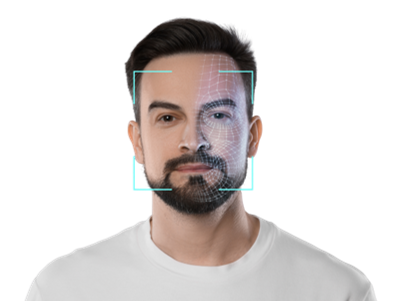
Increased application volume creates one challenge for recruiting teams. More concerning is AI's ability to help candidates misrepresent experience and capabilities or even create entirely fabricated profiles and identities.
Generative AI has industrialized two things at once: the ability to fabricate credentials, and the ability to fabricate the people behind them. A 2025 Greenhouse survey found that 91% of U.S. hiring managers have caught or suspected AI-driven candidate misrepresentation, including AI-assisted interview scripting, fake voices and backgrounds, and deepfake video (89% in Europe).17
The more extreme cases are no longer theoretical. Pindrop documented a single job posting that attracted more than 800 applications in a matter of days; of 300 candidate profiles the company analyzed, more than a third were entirely fabricated.18 Gartner predicts that by 2028, one in four candidate profiles worldwide could be fake.18
The challenge for TA isn't managing more applicants. It's determining which signals are reliable, which candidates are qualified, and whether the person behind the application is who they claim to be.
1 in 4candidate profiles worldwide could be fake by 2028.10
~90% of hiring managers have seen candidates use AI deceptively.17
More applicants don't necessarily mean more qualified candidates. Greenhouse CEO Daniel Chait describes an “AI doom loop” in which candidates use AI to apply to more jobs, driving up application volume and pushing recruiters to rely more heavily on AI to screen it.19 Candidates who struggle to get noticed then apply even more broadly, continuing the cycle. The result is more activity on both sides making it harder for the right candidates and employers to find each other.
Traditional screening methods are becoming less reliable. Resumes, applications, and interview responses are all being enhanced with AI, making polish less indicative of actual capability. When AI crosses into misrepresentation, the stakes become even higher. TA teams need stronger ways to validate whether the experience, skills, and capabilities being presented are real.
Candidate fraud raises the stakes. Hiring someone who has fabricated their identity, experience, or credentials goes beyond the cost of a traditional bad hire. It introduces financial and reputational exposure and, once that person has access to company systems and data, potential cybersecurity risk. Quality of hire now also depends on confidence that the candidate is both qualified and authentic.
Verification needs to happen earlier. Most hiring processes were designed to verify identity and credentials toward the end of the funnel. But only 19% of hiring managers report being extremely confident in their ability to identify fraudulent applicants.20 As candidate fraud becomes more sophisticated, verification can't rely on a final background check alone. It needs to be embedded throughout the process.
19% Just 19% of hiring managers are confident they can spot a fraudulent applicant.20

Hiring processes were built around an assumption of authenticity. AI is making that assumption harder to maintain.
The goal isn't to treat every candidate with suspicion. It's to design a hiring process that can handle greater volume while giving employers confidence in both the authenticity and capability of the people they hire.
Verification is becoming a design principle, not simply a compliance step. That means building identity confirmation into the process, assessing capability throughout the funnel, and relying on recruiter judgment where automation falls short.
As AI changes the candidate market, quality of hire will increasingly depend on how well technology, process, and recruiter judgment work together.
Chapter 4
As AI changes the work people do, employers need a broader view of what people need to contribute.
For much of the past decade, employers have worked to make hiring more precise by shifting focus from credentials to skills. Instead of requiring a bachelor's degree, job postings increasingly specify what candidates need to know or do. This was meaningful progress that opened opportunities to candidates who had been screened out by requirements that said little about their ability to perform the work.
Today, AI is changing the work underneath many jobs. Routine tasks are increasingly supported or performed by technology, roles are evolving faster, and employees are being asked to apply their knowledge in new ways.
That makes a list of skills increasingly incomplete. Employers still need technical expertise, but they also need to understand whether someone can apply it with judgment, adapt as the work changes, bring relevant context, and work effectively with emerging technology.
According to NACE's latest Job Outlook 2026 Survey, 70% of employers now report using some form of skills-based hiring.21
Yet research from Harvard Business School and the Burning Glass Institute found that among employers that removed degree requirements, the share of workers hired without degrees increased by just 3.5 percentage points; across overall hiring, fewer than 1 in 700 hires benefited from the reforms.22
Removing credentials from a job description is only part of the shift. Employers also need to reconsider what they are assessing for.
70% of employers have implemented a skills-based hiring model.21

Businesses don't hire people to possess skills. They hire people to produce outcomes.
Two candidates can have similar skills and perform very differently in the same role. The difference is often how well they combine what they know with judgment, context, adaptability, and technology to solve the problem in front of them. That is capability.
The specific skills the work requires. This is what skills-based hiring already captures well, and it remains the foundation.
The ability to make good decisions under conditions of ambiguity, incomplete information, or competing priorities. It is also what employers are increasingly seeking.
Knowledge of the industry, function, or business in which the work takes place. It provides the context needed to apply skills effectively and make better decisions.
Applying and developing knowledge as the work changes, whether because the market shifts, the technology evolves, or the strategy pivots.
The comfort and competence with AI tools, agentic systems, and other emerging technologies. Once a niche capability, technology fluency is quickly becoming a baseline requirement across a growing range of roles.
Select each capability to see what it means.
As skills change, organizations need to reconsider what they need from permanent talent. As AI takes on more tasks, some of the skills historically associated with a role may become less relevant while judgment, adaptability, domain expertise, and technology fluency become more important.
For permanent hires, that makes capability particularly important. Organizations aren't only hiring for the work that needs to be done today. They need people who can continue to contribute as the role, technology, and required skills evolve.
Some skills can be developed, supplemented through external expertise, or supported by technology. The capabilities that allow someone to apply, adapt, and build on what they know become increasingly important when making a longer-term hiring decision.
Capability is what turns knowledge and skills into outcomes. It reflects how effectively someone can apply what they know in the context of the work.
AI isn't simply eliminating tasks. It is changing the mix of work people perform. As technology takes on more routine execution, the work left to people increasingly depends on judgment, problem-solving, adaptability, communication, and the ability to use technology effectively.
PwC's 2026 Global AI Jobs Barometer found that roles where AI automates routine work and places greater emphasis on human judgment are seeing twice the growth in job openings and 42% faster salary growth than roles where AI makes the work easier for non-experts to perform.23 AI-exposed entry-level roles are also seven times more likely to require traditionally senior-level human skills such as leadership, creativity, and face-to-face interaction.23
7x higher demand for senior-level human skills in AI-exposed entry-level roles
LevelUP's analysis of global job postings shows a similar pattern. Roughly 30% of the skills identified are human skills: capabilities built on judgment, interpersonal interaction, and behavioral effectiveness rather than tool or system proficiency.
These are the capabilities that determine whether technical knowledge gets applied. A candidate's judgment does not appear as a line item on a resume. It shows up in how they work.
Capability changes what “qualified” looks like. As work changes, matching candidates against a fixed list of skills becomes less predictive of how well they will perform. Technical knowledge remains important, but TA also needs to understand how candidates apply that knowledge, exercise judgment, adapt to new situations, and work effectively with technology.
That can change who rises to the top of the candidate pool. The strongest candidate may not have the background that most closely mirrors the job description. Adjacent experience, domain expertise, adaptability, or demonstrated judgment can make someone better equipped to perform as the role evolves.
The signals TA relies on need to evolve. Skills and experience are relatively easy to identify on a resume. Capability is harder to reduce to a list of requirements because much of it shows up in how someone approaches the work.
That puts more weight on assessment. Recruiters and hiring managers need opportunities to see how candidates think through unfamiliar situations, apply their expertise, make decisions with incomplete information, and adapt when circumstances change.
For TA, the better question is whether a candidate can apply what they know to deliver the outcomes the role requires.
Skills-based hiring has gotten us a long way by broadening how we define qualified talent. Now we need to look beyond the skills match and understand how well someone can apply what they know, adapt as the work changes, and continue to add value as the role evolves.
 Amie HibbinsLevelUP Chief Operating Officer
Skills-based hiring was an important evolution to credential-heavy recruiting, but it was never meant to be the end point. As roles become broader, less predictable, and more influenced by AI, employers need a fuller view of what people can contribute. Capability provides that broader view by focusing on how people combine and apply what they know to produce outcomes.
For talent acquisition, the opportunity is to build on the progress of skills-based hiring. Skills remain essential, but as the work changes, employers also need to understand how candidates will apply and build on them over time.

Talent acquisition is entering 2027 with more than a new set of tools. The environment around hiring has changed.
Experienced talent is harder to access. AI is reshaping recruiting and the candidate market. Traditional signals are becoming less reliable. And as AI changes the work itself, employers need a broader view of what people need to contribute.
The opportunity isn't to compete harder within the same hiring model. It's to build a better one.
That means widening the talent pool, using AI to create capacity for more valuable human interactions, strengthening how candidates are assessed and verified, and looking beyond a skills match to understand whether someone has the capability to contribute as the work evolves.
The fundamentals of recruiting haven't changed. Organizations still need to find great people and make good hiring decisions. But the workforce, the candidate, and the work are changing.
The hiring model has to change with them.
About LevelUP
LevelUP helps organizations build better hiring models through RPO, Embedded Recruitment, Contingent Workforce Management, Total Talent, and HR Advisory. We combine recruiting expertise, talent intelligence, global delivery, and AI-enabled technology to help clients access talent, improve hiring outcomes, and adapt as workforce needs change.
Our LevelUP Hiring Engine brings AI and automation into the recruiting process to accelerate sourcing, screening, engagement, and orchestration while keeping recruiters at the center of the interactions and decisions where human judgment matters most.
Technology alone doesn't hire people. People do. We help make both work better together.
How does your hiring model need to evolve? Let’s talk about what comes next.
A practical framework for deploying responsible AI in recruitment with confidence.
Download the Responsible AI in Recruitment roadmap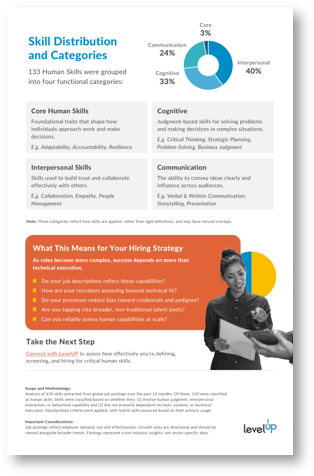
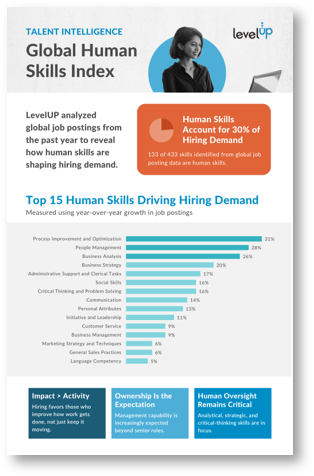
LevelUP's talent intelligence team analyzed global job posting data from the last 12 months to understand how human skills are influencing hiring demand.
Download the Global Human Skills IndexThis report draws on two categories of research. The first is LevelUP's proprietary analysis of global job postings, conducted using Lightcast active job posting data from August 2021 through July 2026. This dataset underpins analyses in Chapter 1 (experience band distribution and growth rates) and Chapter 4 (The Top 15 Human Skills Driving Demand). The second is published research from third-party sources cited throughout the report. All figures are attributed at point of use.
LevelUP proprietary analysis. Job posting data drawn from Lightcast's active global job postings database. Experience bands defined as 0–2 years (entry-level), 3–10 years (mid-experience), and 10+ years (senior). Growth rates are compound annual growth rates (CAGR) across the 2021-2026 period unless otherwise noted.
Human Skills Index (Chapter 4). Analysis of 433 distinct skills extracted from global job postings over a 12-month period. Skills classified as human skills based on two criteria: (1) they involve human judgment, interpersonal interaction, or behavioral capability, and (2) they are not primarily dependent on tools, systems, or technical execution. Hybrid skills assessed based on primary usage. Categories (Core, Cognitive, Interpersonal, Communication) reflect how skills are applied and may have natural overlaps.
Third-party sources. Third-party research is used to contextualize and reinforce LevelUP's proprietary findings, not to substitute for them. Where multiple sources address the same phenomenon, the most recent and methodologically rigorous is cited.
Important considerations. Job postings reflect employer demand, not skill effectiveness or actual hiring outcomes. Growth rates are directional and should be viewed alongside broader labor market trends. Findings represent cross-industry, global insights rather than sector- or region-specific data unless explicitly noted.
Complete the form and we'll email you the 2027 State of Talent Acquisition Report.